The Quiet Trap of Anxious Compatibility
The Quiet Trap of Anxious Compatibility
Here is something I have noticed after years of working with people on their relationship patterns: the most dangerous kind of incompatibility is not the obvious kind. It is not the one where two people want entirely different things and both know it. That kind is painful, but it is at least honest. The dangerous kind is when one person molds themselves so thoroughly around what the other person seems to want that real compatibility becomes impossible to assess — because one of the people in the relationship has temporarily stopped existing.
I call this anxious compatibility, and it is far more common than people realize.
It tends to start small. You notice that they light up when you share a certain interest, so you emphasize that interest. You sense they prefer low-conflict, so you smooth over the things that bother you. Over time, without quite deciding to do it, you have built a version of yourself that is optimized for this one person’s comfort. The relationship feels easy. They often say you are so easy to be with. And you interpret that as evidence of a genuine connection, when what you have actually built is a performance.
The irony is that anxious compatibility often emerges from a genuine desire to be a good partner. The problem is not the impulse — care and consideration are good things in relationships. The problem is that it gets tangled up with a fear of being too much, taking up too much space, or expressing a need that drives the other person away. When consideration is fear in disguise, it does not create intimacy. It creates a version of you that is quietly disappearing.
One of the things I encourage people to do — and that journaling and honest self-reflection genuinely support — is to track the moments where they soften or suppress. Not obsessively, not as evidence against themselves, but as information. When did you hold something back? When did you agree when you did not quite agree? When did you feel something and choose not to say it? Those moments accumulate. They tell a story about how much of yourself is present in the relationship.
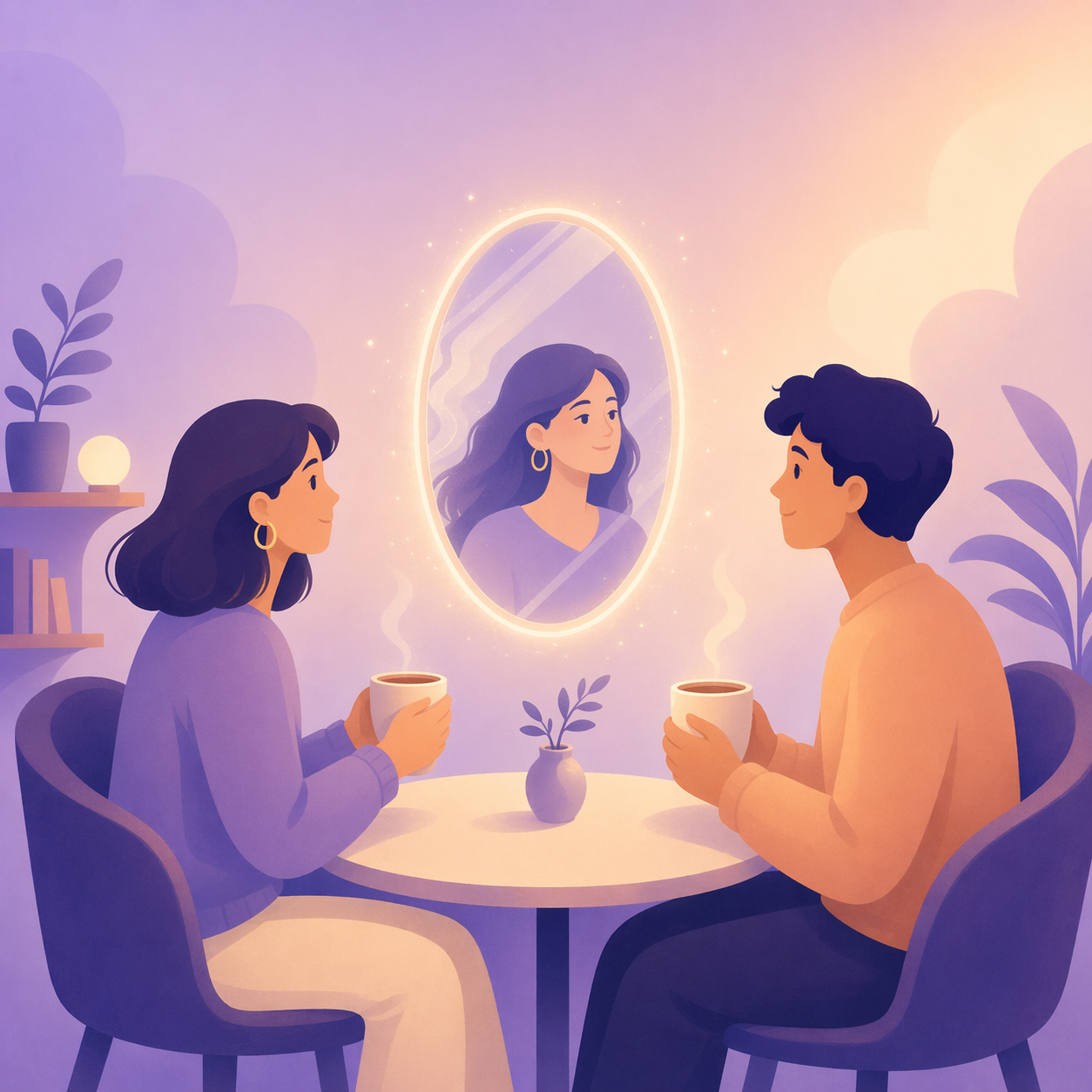
Because here is the thing about real compatibility: it requires two actual people. You cannot genuinely connect with someone if the version of you they know was designed to be acceptable to them. That is not partnership. It is a long audition.
The work is not to become more difficult or to manufacture conflict where there is none. The work is to figure out what you actually want, what you actually think, and whether there is room for that in this relationship. Sometimes there is. Often, when people stop performing compatibility and start showing up as themselves, the relationship gets harder for a while — and then either it deepens into something real, or it becomes clear that it was never going to.
Either outcome is more honest than the alternative.
If you want a clearer view of your own patterns, download DaterGraph on iPhone or Android.
Valentina Cruz-Reyes writes “Honestly, Though” for DaterGraph. She is a Colombian-American relationship coach and attachment-informed therapist based in Miami.